
Jet fuel prices on Wednesday were hiked by over 18 per cent -- the steepest ever increase -- to all-time high levels after international oil price surged to a multi-year high.
Not only do you need an effective and independent regulator, you also need competition to flourish.
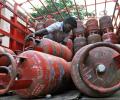
The cost of non-subsidised LPG -- the one that consumers buy after exhausting their quota of 12 bottles of 14.2-kg at below market price -- has been cut by Rs 100.5 to Rs 637.

Government's fuel subsidy estimate was based on crude oil at $70.

Key infrastructure sectors -- from railways to power, and from coal to petroleum -- will not only be part of the achievements but promises too, as the BJP fights to get a third term at the Centre.

Domestic LPG prices may go up by Rs 22-25 per cylinder this week as oil companies push for a hike in retail selling price in view of Budget 2003-04 lowering subsidy provision for cooking gas and PDS kerosene.
Govt diverts Rs 253-crore subsidy savings to the poor.

In Mumbai, jet fuel costs Rs 71,940.36 per kl as against Rs 73,306.89 per kl previously, IOC said.
The government is considering a 3-rupee to 5-rupee hike in the price of diesel, which accounts for more than 40 percent of fuel use, government officials said last week, as the country looks to cut import costs by nearly $20 billion to trim a record current account deficit.
State-run oil marketing companies on Monday raised the security deposit for new cooking gas (LPG) connections to Rs 1,250 from the existing Rs 850 per cylinder, as also the price of cylinder regulator due to increase in input costs.

The Bharatiya Janata Party on Thursday released its manifesto for the October 5 Haryana assembly polls, promising a monthly assistance of Rs 2,100 for women, two lakh government jobs for the youth and guaranteed government job for Agniveers hailing from the state.

Government-controlled oil-marketing companies (OMCs) have held back petrol and diesel price revisions for a week and are expected to continue doing so, ostensibly owing to political reasons. It appears that the Centre has informally conveyed to the three major OMCs to not revise fuel prices for the time being, two people in the government said. This informal directive follows the talks between the Centre and states on cutting taxes and bringing the auto fuels under the good service tax regime not fetching the desired results, so far.
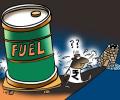
Finance Minister Nirmala Sitharaman on Monday ruled out a cut in excise duty on petrol and diesel to ease prices, which have touched an all-time high, saying payments in lieu of past subsidised fuel pose limitations. Petrol and diesel as well as cooking gas and kerosene were sold at subsidised rates during the previous Congress-led UPA government. Instead of paying for the subsidy to bring parity between the artificially suppressed retail selling price and the cost that had soared because of international rates crossing $100 per barrel, the then government issued oil bonds totalling Rs 1.34 lakh crore to the state-fuel retailers. These oil bonds and the interest thereon are being paid now.
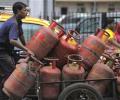
The increase in commission - which is normally passed on to consumers - is expected within a couple of weeks.

'The economic crisis hit us from nowhere. No one saw it coming.'
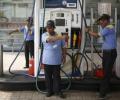
State-owned fuel retailers are losing close to Rs 3 per litre on selling diesel while the profit on petrol has trimmed due to recent firming up in international oil prices, industry officials said detailing reasons for continuing to hold retail prices. Indian Oil Corporation (IOC), Bharat Petroleum Corporation Ltd (BPCL) and Hindustan Petroleum Corporation Ltd (HPCL), who control roughly 90 per cent of India's fuel market, 'voluntarily' have not changed petrol, diesel and cooking gas (LPG) prices for almost two years now, resulting in losses when input cost was higher and profits when raw material prices were lower.
LPG price was increased to Rs 858.50 per 14.2 kg cylinder from Rs 714 previously, according to a price notification from State-owned oil firms. This is the steepest hike in rates since January 2014, when prices had gone up by Rs 220 per cylinder to Rs 1,241.
Global crude oil prices have slumped by 49 per cent during the same period
Despite the steep hike of Rs 20 per LPG cylinder announced last week, domestic cooking gas in India is still the cheapest in the subcontinent.
The phased increase of prices is being done to sell the fuel at international prices.

The government does not seem inclined, at least in the petroleum sector, to effect sudden and steep upward price revisions to tame its huge subsidy burden and rein in fiscal deficit.

In the Upper House of Parliament, Chairman M Venkaiah Naidu did not allow adjournment notices moved by opposition members on the issue of price rise, prompting members of the Congress, the Trinamool Congress, the Left parties, the Dravida Munnetra Kazhagam, the Aam Aadmi Party, the Nationalist Congress Party, the Rashtriya Janata Dal and the Shiv Sena to create an uproar.
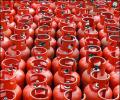
In a move that will give cooking gas consumers more choice, state oil marketing companies have started selling mini 5-kg LPG cylinders at subsidised rates.

'Those who feared that I would have run one hell of a campaign targeting the most powerful people in India snatched away my democratic right from me.' 'I will expose these democracy-killers.'

Experts say having an open fire in the kitchen is like burning 400 cigarettes an hour.

'We are happy that the money has come to us immediately after it was announced.' 'For once, the government did what it promised.'

Why did Karnataka's economic prosperity fail to influence the nature of electoral promises made by political parties in the run-up to the assembly elections? asks A K Bhattacharya.
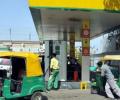
CNG price in the national capital and adjoining cities on Tuesday was hiked by Rs 0.50 per kg, while an imminent increase in petrol and diesel price has been put on wait-and-watch mode for more clarity on global oil prices. CNG price in NCT of Delhi has been increased to Rs 57.51 per kg from Rs 56.51, according to the information posted on the website of Indraprastha Gas Ltd - the firm which retails CNG and piped cooking gas in the national capital. Following the firming up of international gas rates, IGL has been raising CNG rates by up to 50 paise (Rs 0.50) per kg periodically. Prices have gone up by about Rs 4 per kg this year alone.

Diesel in Mumbai costs Rs 79.72 per litre at IOC outlets and Rs 79.79 at BPCL outlets.
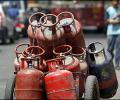
The price of subsidised cooking gas was on Tuesday hiked by over Rs 2 per cylinder, the sixth increase in rates in five months, while that of jet fuel was raised by a steep 7.3 per cent in step with global trends.

Since August, petrol price has been cumulatively cut by Rs 9.36 per litre.

Domestic cooking gas consumers in Delhi and Mumbai will from Wednesday get cash subsidy for buying cooking gas refils as the Direct Benefit Transfer for LPG (DBTL) Scheme will be extended to 105 more districts.

The excise duty cut will translate into a reduction of Rs 9.5 a litre on petrol and Rs 7 a litre in diesel after taking into account its impact on other levies.
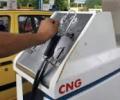
The Petroleum Ministry in an order on Wednesday said it has revised guidelines for allocation/supply of domestic natural gas to city gas distribution entities for CNG and piped cooking gas sector.

One of the reasons is that the retail prices are not bench-marked to crude but their respective international benchmark prices.
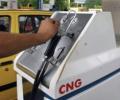
Piped cooking gas rates are also increased by Re 1 with effect from midnight.
The price of non-subsidised cooking gas (LPG) was on cut by Rs 21 per cylinder and that of jet fuel (ATF) by a steep 3 per cent on the back of falling international oil rates.
The price of Compressed Natural Gas (CNG) may be hiked by up to Rs 2 per kg in the next few days as rupee devaluation has pushed up input cost.

'This might prove to be a temporary gain for the BJP, but at a huge cost to the people of Gujarat and democracy in India.'
ATF or jet fuel price has been cut marginally while rate of non-subsidised cooking gas LPG has been hiked by Rs 27.50 a cylinder.
 © 2026 Rediff.com - Advertise with us - Disclaimer - Privacy Policy - Sitemap - Feedback - About us - Terms of use - Grievances